
Developing an Ectoin Cream People Want to Use Every Day
Ectoin concentration belongs in the same discussion as texture, use conditions and product evidence. We look at ingredient selection, dose screening, processing and packaging through the development of an everyday cream.
With an ectoin cream, the first things a person notices are usually how it spreads, what remains after application and whether their skin still feels comfortable later. A percentage on the label cannot answer those questions. We start with the daily routine the cream needs to fit, then decide what ectoin should contribute to the formula.
Give the daily routine a place in the brief
Moisturizing and barrier care are not yet a complete development brief. A daytime cream used in air-conditioned rooms needs to work under sunscreen and makeup. Evening care for drier skin may call for a richer finish. A cream for humid conditions needs close attention to tack and the feeling left on skin.
We consider intended users, time of use, climate and layering habits together. These choices help define the emulsion, emollient profile and residual feel before we discuss active ingredients. They also give us a useful basis for judging prototypes.
Be clear about what ectoin contributes
Ectoin is the INCI name of a compatible solute available commercially through fermentation processes. In skincare development, we are interested in research relating it to hydration environments, moisturization and comfort.
A hydration shell is a useful phrase in discussions of the mechanism, but it should not suggest a sealed coating on the face. Molecular research provides a direction for understanding the ingredient. A cream's performance still depends on its water phase, oil phase, emulsion structure and supporting ingredients.
Humectants such as glycerin, suitable emollients and the lipid system each have work to do. Adding ectoin does not remove the need for those foundations, or automatically give a cream sun protection or a role in treating skin disease.
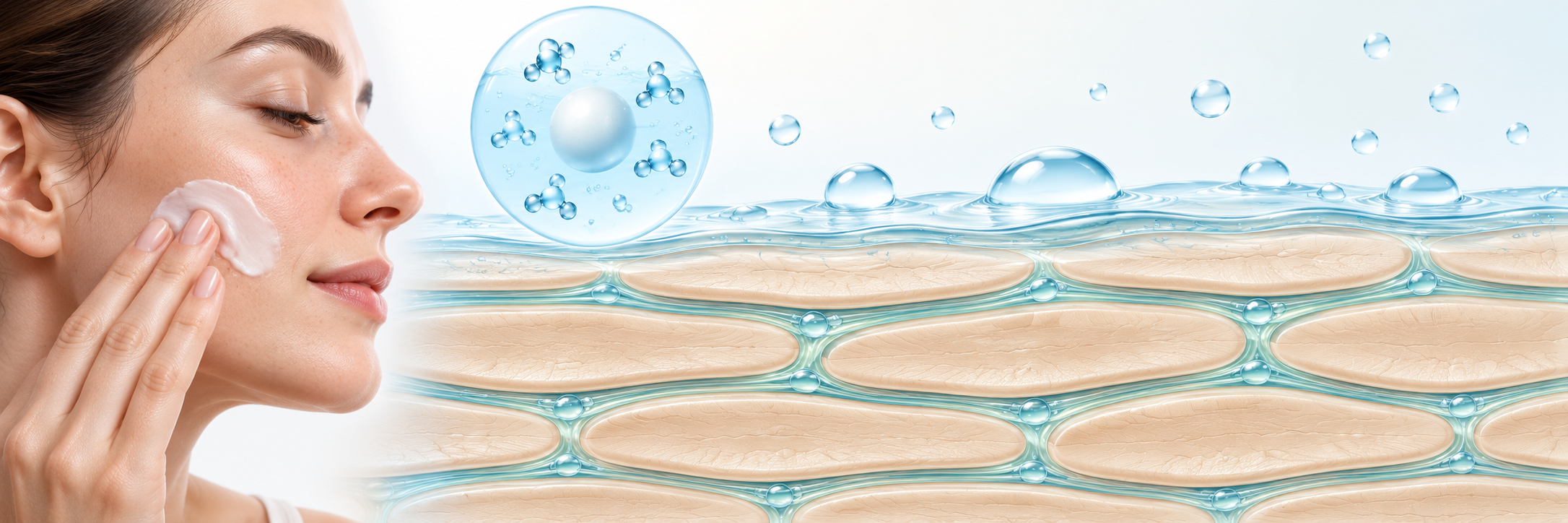
Schematic of skin hydration and the outer barrier. Structures are simplified and do not demonstrate product penetration or efficacy.
Use prototypes to choose the concentration
We do not treat one percentage as the starting point for every ectoin product. First we confirm the actual active content, supplier guidance and relevant requirements for the intended market. Then we select a small number of candidate levels in the same base formula.
The comparisons should keep other conditions as consistent as possible. If emollients, thickeners and fragrance all change with the ectoin level, the reason for a difference becomes difficult to identify. We look beyond the initial hydrated feel to spreading, residue, pilling when layered and tolerance during use.
If a higher level adds cost or makes the texture harder to balance without a clear benefit at the intended endpoint, a larger label number is not a reason to keep it. The final concentration should make sense in both the formulation record and the validation plan.
Water solubility does not finish the process design
Ectoin's water solubility is useful to formulation work. Addition stage, temperature and exposure time should still follow the technical documentation for the material in use and the actual manufacturing process. We record pre-dissolution, addition temperature, mixing and final pH so that a successful small batch can be investigated properly at scale.
A stable ingredient does not establish a stable cream. Emulsion structure, preservation, fragrance and packaging can all influence the result. Compatibility needs to be assessed in the complete formula, even when the individual ingredients are familiar.
Test the formula and its package together
We separate two kinds of observation. The first concerns changes in the product: separation, crystals, colour, odour, pH or viscosity. The second concerns use: pump delivery, residue at the opening, repeated opening and closing, and application. Active assays may also be appropriate.
Temperature cycling and accelerated conditions can expose risks; they do not directly establish the whole shelf life. Conditions and observation periods should reflect the formula, distribution, package and intended use. Microbiological quality, preservative protection and tolerance in the intended population require appropriate assessments of their own.
If hydration is the central product value, the endpoints should address hydration. Specific soothing or barrier-related language needs evidence that matches the wording. Ingredient documentation cannot take the place of finished-product validation.
Compare candidate formulas, then assess processing and packaging against the same product brief.
Decide what the pack should say early
We prefer to write the sentence we want a customer to understand, then ask what would support it. A statement about skin feeling more comfortable and a change in an instrumental measurement do not use the same endpoint. Clear wording makes the validation plan easier to align.
Contains ectoin describes an ingredient's presence. On its own, it does not support claims about treating dermatitis, medical-grade performance or other medical outcomes. Environmental-protection language should identify the factor and assessment involved, rather than letting a broad protection claim imply SPF.
Product classification, ingredient requirements, labeling and efficacy language need review for each intended market. We place that work before formula and artwork approval, while the project can still respond to it.
Start the next sampling round with a one-page brief
Instead of a request for a high-percentage ectoin cream alone, we want to know where it will be sold, who will use it, whether it belongs in a day or evening routine, the preferred richness, any sunscreen or makeup layering needs, and the single product benefit that matters most to validate.
Add a cost target, package direction and launch window, and we can discuss material selection, meaningful prototype differences and testing priorities. Ectoin deserves thoughtful formulation. A cream people choose to use every day still depends on the whole system.
Planning an ectoin skincare product? Share your intended market, use conditions and preferred texture so we can define sampling and validation needs.